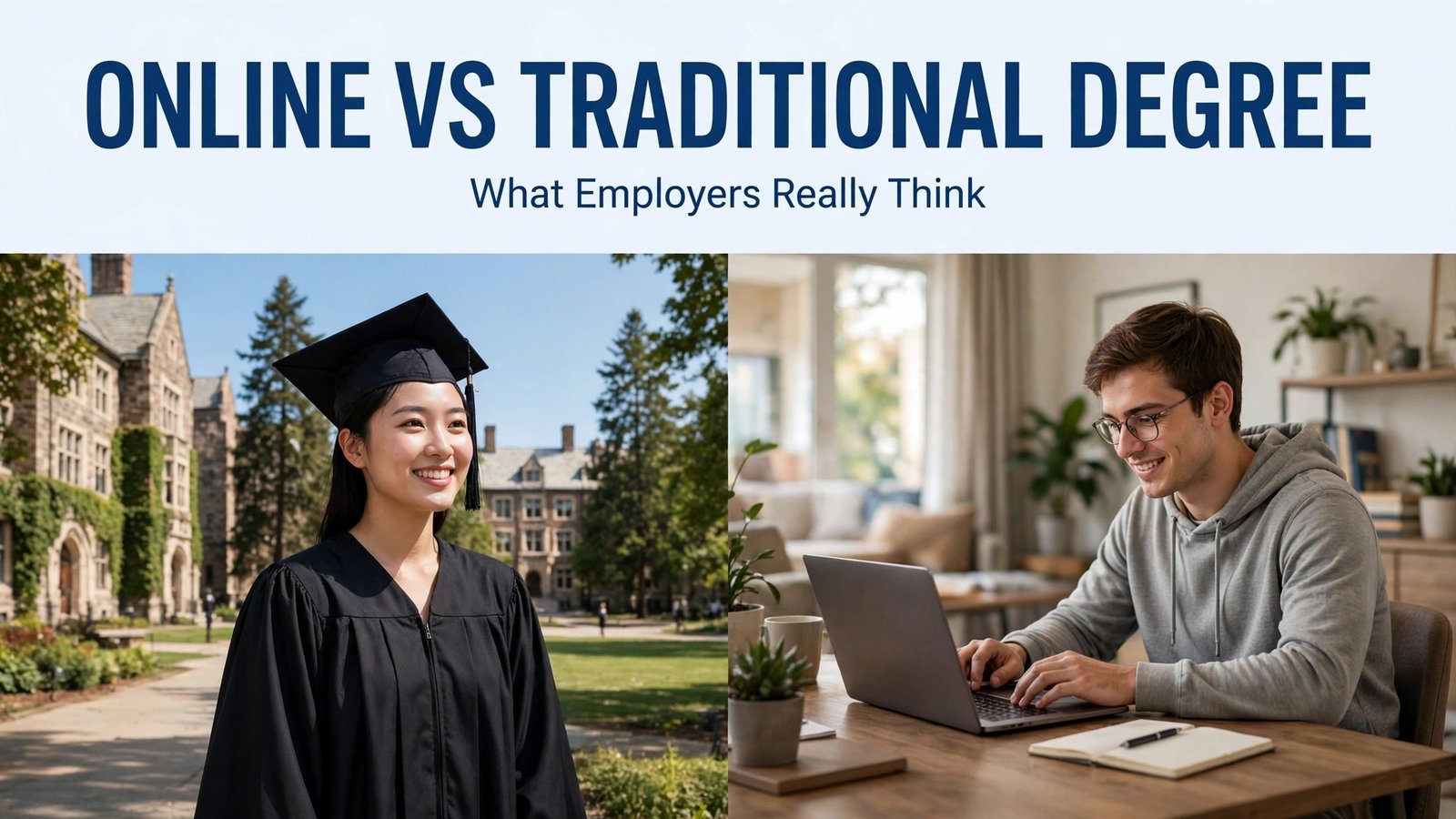
“Will employers respect an online degree?” It is the question almost every adult asks before enrolling — and a fair one. A degree is a major investment of money and years of evenings. The short answer is that employer attitudes have shifted dramatically as online education has become mainstream, but the details matter: what employers really evaluate is the institution, its accreditation, and what you can do — not whether your classroom had walls.
This article breaks down how hiring managers actually view online degrees today, where skepticism still exists, and how to choose a program that strengthens rather than limits your career.
How Employer Views Have Changed
Online degrees were once associated mainly with for-profit schools of uneven quality, and some hiring managers formed lasting impressions during that era. Since then, the landscape has changed completely. Most established colleges and universities — including highly selective ones — now offer online programs, a shift that accelerated when remote learning became universal. When a well-known university awards the same degree online and on campus, the distinction loses meaning.
Human resources professionals today generally focus on three questions: Is the institution accredited? Is it a real, established school? And does the candidate have the skills and experience for the job? Delivery format rarely makes the list, particularly for roles where remote work itself is normal.
What Employers Actually Check
Accreditation
This is the employer’s first filter. Degrees from institutions accredited by agencies recognized by the U.S. Department of Education or CHEA are broadly accepted. Degrees from unaccredited schools are frequently rejected outright, and some employers and government agencies verify accreditation during background checks. If you are unsure how accreditation works, read our explainer on regional vs national accreditation before choosing any program.
The institution’s reputation
Employers respond to names they know: established public universities, long-standing private colleges, and schools with a real campus and history. A degree from a recognized institution reads the same whether you studied online or in person. New, unknown, or heavily advertised schools invite more scrutiny regardless of format.
Your experience and skills
For adult learners, this is the good news: employers weigh your work history heavily. An online degree earned while working full time actually signals discipline, time management, and digital fluency — qualities hiring managers repeatedly say they value. Your portfolio, certifications, and references usually matter more than how you attended lectures.
Does the Diploma Say “Online”?
In most cases, no. The large majority of colleges award the identical diploma to online and on-campus graduates, and transcripts typically do not flag the delivery method either. From an employer’s perspective, a degree from an accredited university is simply a degree from that university.
Where Caution Still Exists
A few situations deserve honest mention. Some licensed professions — nursing, teaching, counseling, engineering specialties — have clinical, lab, or student-teaching components that cannot be fully online; legitimate programs arrange these locally, and licensing boards care about the license, not the lecture format. A small number of very traditional employers and certain competitive graduate programs still look more closely at unfamiliar online-only institutions, which is another reason the institution’s standing matters more than the format. Finally, networking differs: campus students get incidental contact with peers and faculty, so online students should deliberately build professional connections through internships, associations, and their current workplace.
Online vs Traditional: A Practical Comparison
- Flexibility: Online wins clearly for working adults — asynchronous study fits around shifts and family.
- Cost: Online programs often cost less overall once commuting, housing, and fees are counted, though tuition itself varies widely by school.
- Pace: Many online programs offer accelerated terms and year-round starts; traditional programs follow the semester calendar.
- Interaction: Campus programs offer face-to-face contact; online programs offer discussion boards, video sessions, and sometimes local placements.
- Outcome: For accredited institutions, the credential itself is equivalent — outcomes depend on the school and the student.
Making an Online Degree Work for Your Career
Choose an established, accredited institution — our guide to the best online colleges for working adults covers what to look for. Then treat the degree as one part of your candidacy: keep building experience, earn relevant certifications, complete an internship or capstone with a real employer if offered, and be ready to describe concrete projects in interviews. Employers hire evidence of ability; the degree opens the door.
The Bottom Line for Adult Learners
If you are choosing between an online degree from an established, accredited university and no degree at all — the realistic alternative for many working adults — the comparison is not close. Jobs that require a bachelor’s degree screen for the credential itself, and a qualified applicant with an online degree beats an unqualified applicant without one every time. The format debate mostly matters at the margins: unfamiliar institutions, unaccredited schools, and programs without required licensure components. Avoid those traps, and your online degree will be judged the way it should be — as proof that you met the same standard as any other graduate, while holding down a job at the same time.
Frequently Asked Questions
Do employers verify whether a degree was earned online?
Employers verify the institution, accreditation, and degree awarded — not the delivery method. Since most diplomas and transcripts do not indicate online study, there is usually nothing format-specific to verify.
Is an online degree from a for-profit college viewed differently?
Some employers are more cautious about unfamiliar for-profit institutions, mainly because quality varies. The safest signal remains recognized accreditation plus an established track record, whatever the school’s tax status.
Will an online bachelor’s degree let me into graduate school?
Yes, provided the degree is from an accredited institution. Graduate admissions committees evaluate the institution’s accreditation, your GPA, and your application materials — the same as for campus graduates.
Are online degrees easier than traditional degrees?
Not at reputable institutions. Accredited online programs must meet the same academic standards, and many students find the self-discipline required makes them more demanding, not less.
Key Takeaways
- Employers evaluate accreditation, institutional reputation, and your skills — rarely the delivery format.
- Most diplomas do not indicate that a degree was earned online.
- Choose established institutions accredited by Department of Education- or CHEA-recognized agencies.
- An online degree earned while working signals discipline and digital fluency to hiring managers.
- Pair the degree with experience, certifications, and projects for the strongest candidacy.